
DETOUR / DEVELOPMENT LOG
Day 7 — How to Finish a Game You Don’t Plan to Keep Developing
Finishing DETOUR with audio, lighting, browser polish, and a clear decision about when a jam game is done.
Originally published on itch.io ↗. Reproduced here from the original post.
The last couple of days on DETOUR were quieter than the beginning of the jam.
I didn’t add another major mechanic.
I didn’t build a new system.
I mostly worked on audio, made some small polish passes, cleaned up the browser build, finished the itch.io page, and got the game submitted.
And somewhere in that process, I realized something else:
I don’t think I want to keep developing DETOUR after this jam.
That sounds harsher than I mean it.
I’m happy with the game.
I’m glad I made it.
I learned a lot from it.
But I also think one of the useful skills in game development is being able to tell the difference between:
“This game is finished.”
and:
“This game should become something bigger.”
For DETOUR, I think those are two different answers.
When My Attention Started Drifting
Part of what happened is that I started getting a lot of useful feedback on another game I recently made, DOOM DELIVERY.
That feedback made something very clear to me:
There is something in that game I want to keep exploring.
The controller already works.
People seem to like moving around.
I don’t really want to change the core movement very much at all.
What I want to figure out is everything around it.
How do I make the world more interesting?
How do I create better objectives?
How do I make deliveries feel like more than isolated challenges?
How far can I push that core controller before it stops being fun?
Those questions started occupying more and more of my brain toward the end of this jam.
And at roughly the same time, I was having the opposite realization about DETOUR.
I Think DETOUR Is Done
The original idea for DETOUR was simple:
Do you take the shorter, dangerous road or the longer, safer one?
I still like that idea.
I think it fits THE LONG WAY HOME very directly.
And mechanically, I think the fuel-versus-danger tradeoff works.
But once I started adding enough obstacles, pressure, and difficulty to make the driving engaging, something became much clearer to me:
DETOUR is basically an endless-runner-style game with route decisions layered on top.
That isn’t inherently bad.
There are good endless runners.
There are people who love that genre.
I’m just not especially interested in exploring that structure much further.
Once I recognized that, the goal of the project changed.
I stopped asking:
“How do I turn this into a bigger game?”
and started asking:
“What can I learn by finishing this one properly?”
That turned out to be a much more useful question.
DETOUR Became a Test Bed
Once I stopped trying to imagine some giant future version of the game, I felt much freer to experiment.
There were several things in Godot I either had very little experience with or had never really gotten working the way I wanted.
DETOUR gave me a place to practice all of them.
Polygons
Before this project, I had never been especially comfortable working with polygons in Godot.
A lot of my earlier prototypes leaned heavily on ColorRect.
Rectangle here.
Rectangle there.
Another rectangle pretending to be a car.
Another rectangle pretending to be a road sign.
That works.
But it also limits what you can build.
During DETOUR, I finally got comfortable creating and editing polygon-based objects.
That meant I could start making road debris, barriers, shadows, car details, and other objects with shapes that actually fit what they were supposed to represent.
It sounds like a small thing.
It wasn’t.
It made me feel like I had access to another entire category of visual tools.
Learning to See Objects From the Wrong Angle
One of the stranger lessons from making a top-down driving game was how much it changed the way I looked at ordinary roadside objects.
I see construction barriers.
I see potholes.
I see scraps of debris.
I see signs.
I know what those things look like from inside a car.
But that is not the perspective DETOUR needed.
The game sees everything from above.
So I had to keep asking:
What does this actually look like from the top?
That became a surprisingly interesting design exercise.
A barrier that is immediately recognizable from the front might just look like a couple of narrow boards from above.
A pothole is not really a circle.
Debris needs enough asymmetry to read as debris without becoming visual noise.
The same object can feel completely different once the camera moves.
That was something I had never really thought about before this jam.
Turning Out the Lights
Lighting became another major experiment.
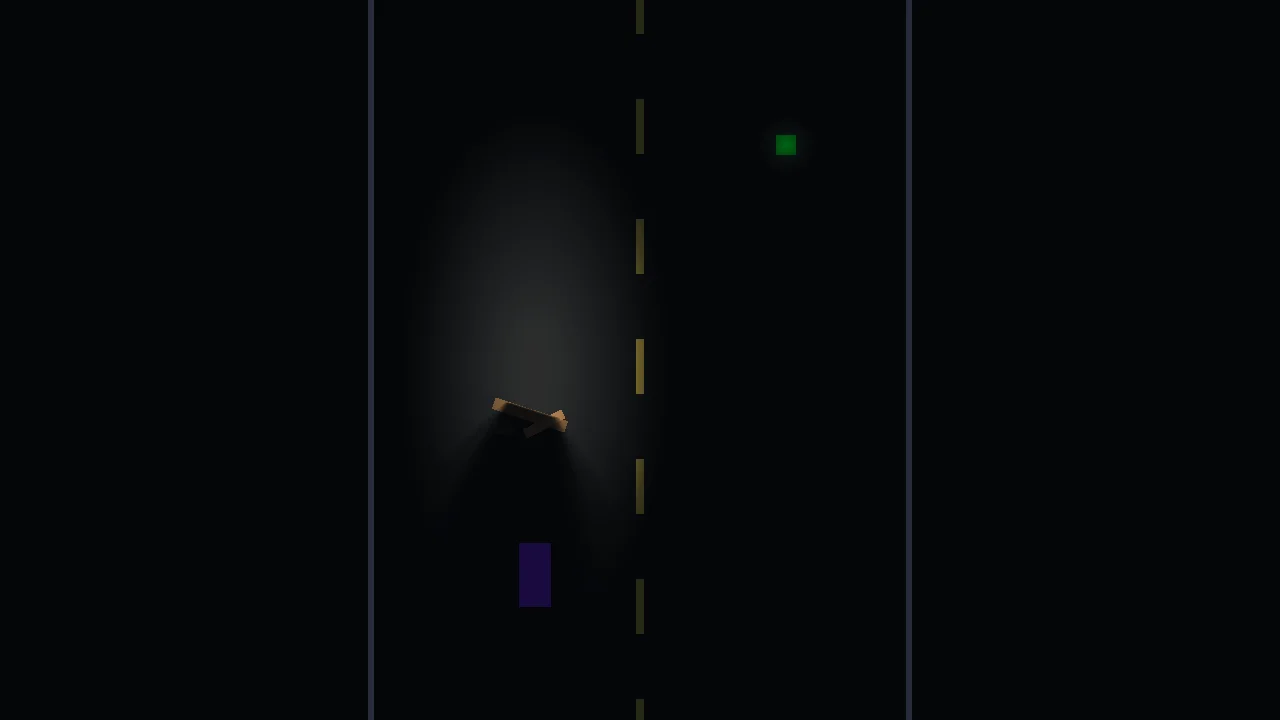
Once I started adding headlights, the entire visual identity of the game changed. Before that, DETOUR was mostly:
- a dark road
- some lane markers
- a purple car
- obstacles moving toward you
The headlights suddenly created focus.
The darkness mattered.
Objects could emerge from visibility instead of simply existing on screen.
Then I started experimenting with LightOccluder2D.
That led to shadows.
And then to figuring out how large those shadows should be.
And then to discovering what happens when your tiny piece of road debris casts a gigantic black triangle across half the screen.
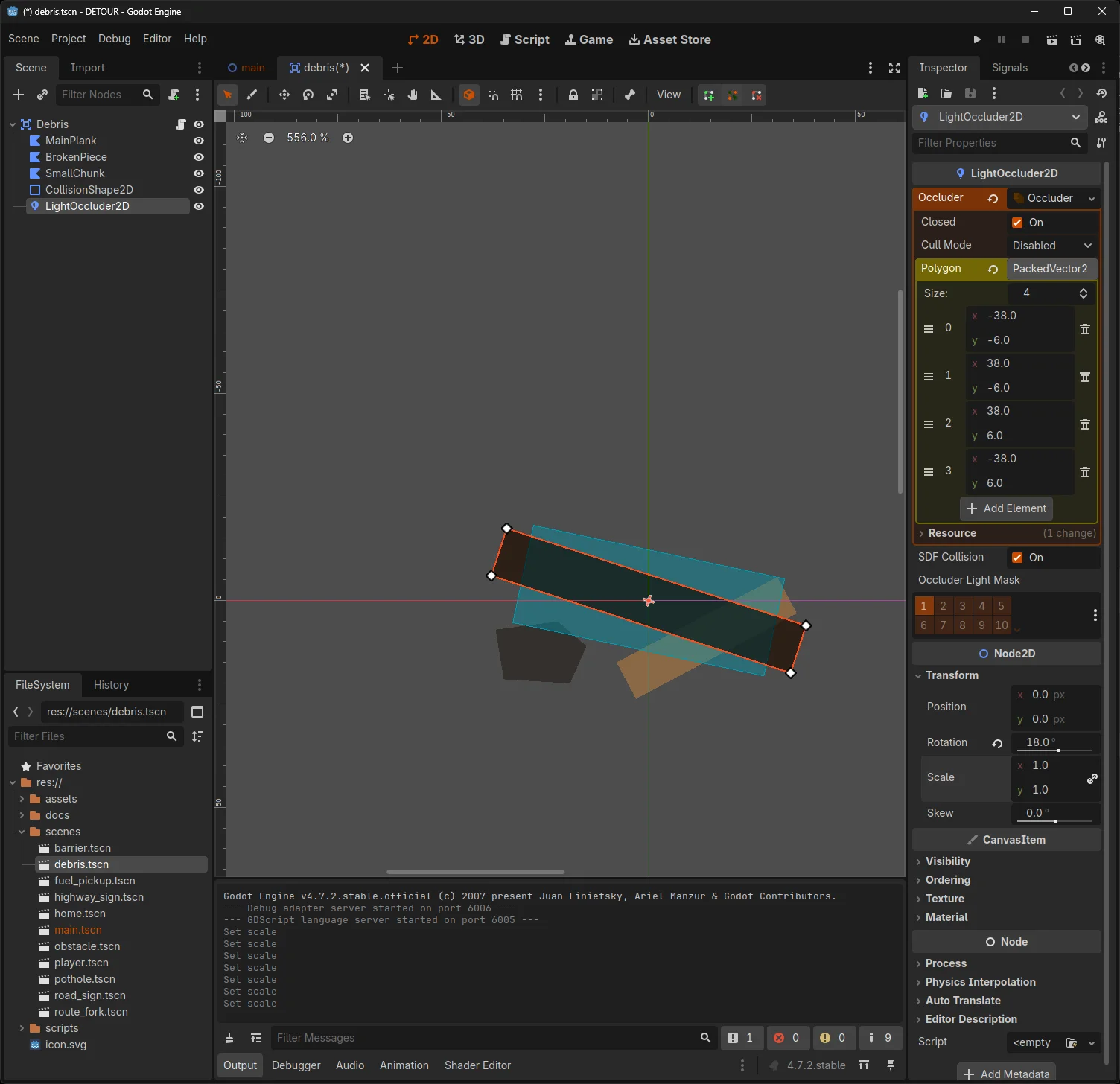
It took some tuning.
But by the end, the lighting system became one of my favorite parts of the project.
Not because DETOUR needed some technically complicated lighting solution.
It didn’t.
But because I now understand Godot’s 2D lighting tools far better than I did a week ago.
That knowledge comes with me to the next project.
Audio Finally Clicked
The last major thing I wanted to improve was audio.
This was probably the clearest example of applying lessons from an earlier project.
When I made DOOM DELIVERY, I knew approximately what I wanted the game to sound like.
But I did not really understand the workflow yet.
I was cutting clips awkwardly.
Some loops were bad.
Some effects were close to the feeling I wanted without actually being right.
The sounds worked well enough to communicate intent, but they did not really feel finished.
This time I approached audio much more deliberately.
I found individual sounds for:
- the engine
- nighttime ambience
- collisions
- fuel pickups
- route selection
- low-fuel warnings
- arriving home
Then I edited them in Audacity.
I trimmed them.
Adjusted them.
Built cleaner loops.
And, in a few cases, combined multiple source sounds into a new sound that fit the game better.
The home-arrival sound, for example, is not simply one downloaded effect.
It is assembled from multiple pieces to create the specific feeling I wanted.
The same is true for some of the smaller notifications.
Then I routed and mixed everything in Godot so the engine did not dominate the ambience, the ambience did not swallow the effects, and important sounds still came through clearly.
That part feels dramatically better than my previous attempt at game audio.
And that is probably one of the things I am happiest about from this entire jam.
The Controller Still Has Something
There is one part of DETOUR that I do think turned out genuinely interesting:
the car controller.
Very early in development, I described what I wanted as:
“Boat, not spaceship.”
I didn’t want the car to instantly move left and right like a cursor.
I wanted weight.
Momentum.
A little body roll.
A feeling that when you start correcting, the car is still finishing the previous movement.
During the slower parts of the game, that controller is not especially dramatic.
There is plenty of road.
There is time to react.
You mostly just steer around things.
But during the shortcut sections, when obstacles start arriving quickly and several lanes become dangerous at once, the controller comes alive.
A tiny timing mistake matters.
You turn slightly too late.
Then you overcorrect.
Then you are in the wrong position for the next obstacle.
Then you clip something.
The impact throws you sideways.
Now your timing is completely different.
And suddenly one small mistake becomes three collisions.
Those sequences can get genuinely tense.
I think that is probably the strongest part of the gameplay.
It also taught me something useful:
A controller can be more interesting than the game built around it.
That does not necessarily mean the entire project needs to grow.
Sometimes it means you take the lesson and use it somewhere else.
Finishing Still Matters
It would have been easy to stop once I realized I probably was not going to keep working on DETOUR after the jam.
That would have been the wrong lesson.
The game still needed:
- proper audio
- balance
- browser export testing
- an itch.io page
- a cover
- a trailer
- credits
- submission information
- final testing
So I finished those things.
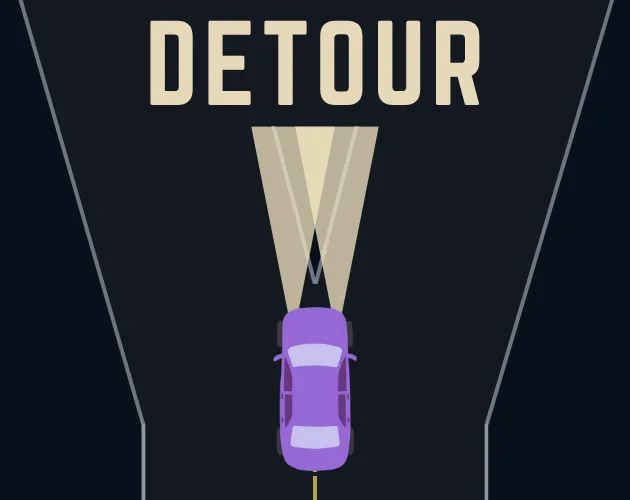
DETOUR now:
- runs in the browser
- has a complete beginning-to-end loop
- has a win state
- has multiple fail states
- has route decisions
- has fuel pressure
- has damage
- has lighting
- has sound
- has a proper presentation
- is submitted to GoedWare Game Jam #17
That matters to me.
There is a huge difference between having a folder full of experiments and having something another person can actually open, play, finish, and judge.
Even if I never touch DETOUR again, it is finished enough to exist on its own.
Was There a Bigger Game Here?
At the beginning of this jam, one of the main questions I was trying to answer was:
Is there actually a game here?
By the end of Day 1, I thought the answer was yes. I still think that was correct. There is a game here. The question I can answer now is a different one: Is there a bigger game here?
Probably not.
At least not one I personally feel excited enough to spend months building.
And I am completely okay with that.
Not every prototype needs a roadmap.
Not every finished game needs DLC.
Not every jam entry needs to turn into your next commercial project.
Sometimes a game can do its job by teaching you something.
DETOUR taught me a lot.
I got better at:
- controller feel
- polygons
- top-down visual design
- 2D lighting
- shadows and occlusion
- audio editing
- sound layering
- mixing
- browser exporting
- finishing
That is a pretty good return for seven days.
The End of the Road
DETOUR is submitted.
Now it belongs to the jam.
I am looking forward to seeing how people react to it during the rating period.
Maybe people will like parts I barely thought about.
Maybe they will hate something I thought worked perfectly.
That is part of the fun.
But from a development standpoint, I think I am done.
And for once, “done” does not mean:
I ran out of energy.
It means:
I learned what I needed to learn, finished what I started, and know what I want to work on next.
That feels like a good place to leave it.
DETOUR
Made for GoedWare Game Jam #17
Theme: THE LONG WAY HOME
Play DETOUR in your browser
7 days. One road home. No perfect way there.