
DETOUR / DEVELOPMENT LOG
Day 1 — From Zero to a Complete Ugly Prototype
Building a complete driving-game loop with simple shapes before getting distracted by polish.
Originally published on itch.io ↗. Reproduced here from the original post.
I started this game jam late.
Work ate the first few days, which left me with seven days to go from an empty Godot project to a finished submission for GoedWare Game Jam #17.
The theme is:
THE LONG WAY HOME
Rather than trying to make something large, I decided to build the smallest game I could think of where the theme directly affects how you play.
That game is DETOUR.
The highway is closed. Your tank is almost empty. Every shortcut is dangerous. Every safe road is longer.
The central question is simple:
Do you risk the shortcut, or take the long way home?
Starting With Almost Nothing
The first goal today was deliberately unimpressive:
Put something on screen and make it move.
My first “car” was a purple rectangle on a gray background.

No road.
No obstacles.
No fuel.
No game.
Just a rectangle that moved left and right.
But once that worked, I had something to build on.
Faking Forward Movement
DETOUR is a top-down driving game, but the car doesn’t actually need to travel through a giant level.
Instead, the player stays near the bottom of the screen while the world moves toward them.
I added a dark road, white edges, and repeating yellow lane markers.
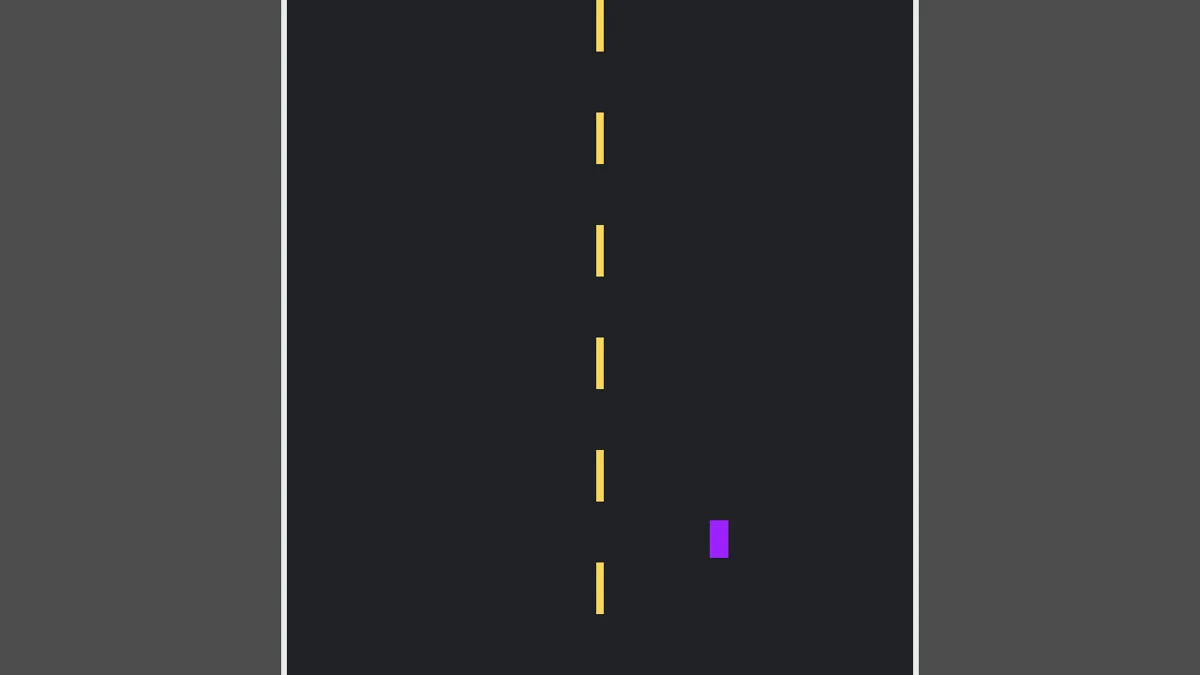
Moving those markers downward immediately created the illusion that the car was driving forward.
This ended up being an important architectural decision because now everything can use the same idea:
- road markings move down
- obstacles move down
- fuel moves down
- junctions move down
- home eventually moves down
The world comes to the player.
For a seven-day game, that is much easier to manage than building an actual traversable world.
First Danger
Next came obstacles.
Right now they are extremely sophisticated red squares.
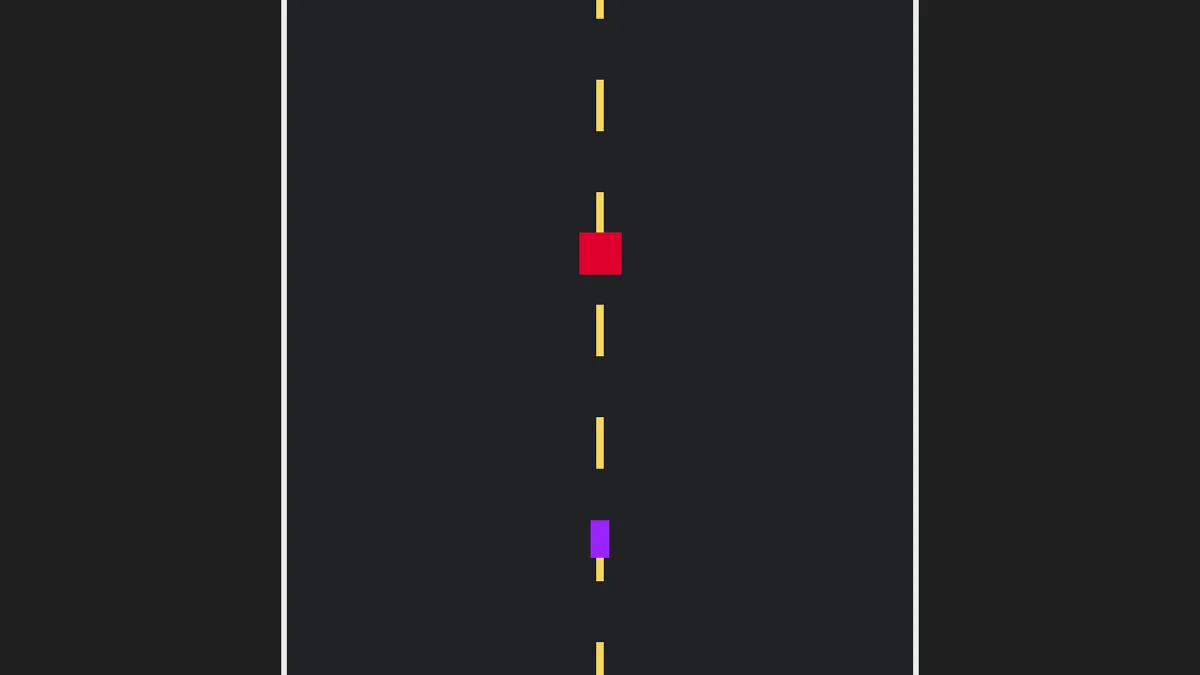
They spawn above the road and move toward the player. Hitting one knocks the car sideways and briefly rotates it.
That small reaction made collisions feel much better than simply deleting the obstacle.
I then added a basic health system:
3 health → hit something → lose health → reach 0 → wreck → restart.
At this point, it finally started feeling less like a movement test and more like a game.
Fuel Changes Everything
Health wasn’t enough for the idea I had in mind.
The entire shortcut-versus-detour decision depends on having two different resources under pressure:
the condition of the car and the amount of fuel left.
So fuel now drains continuously while driving.
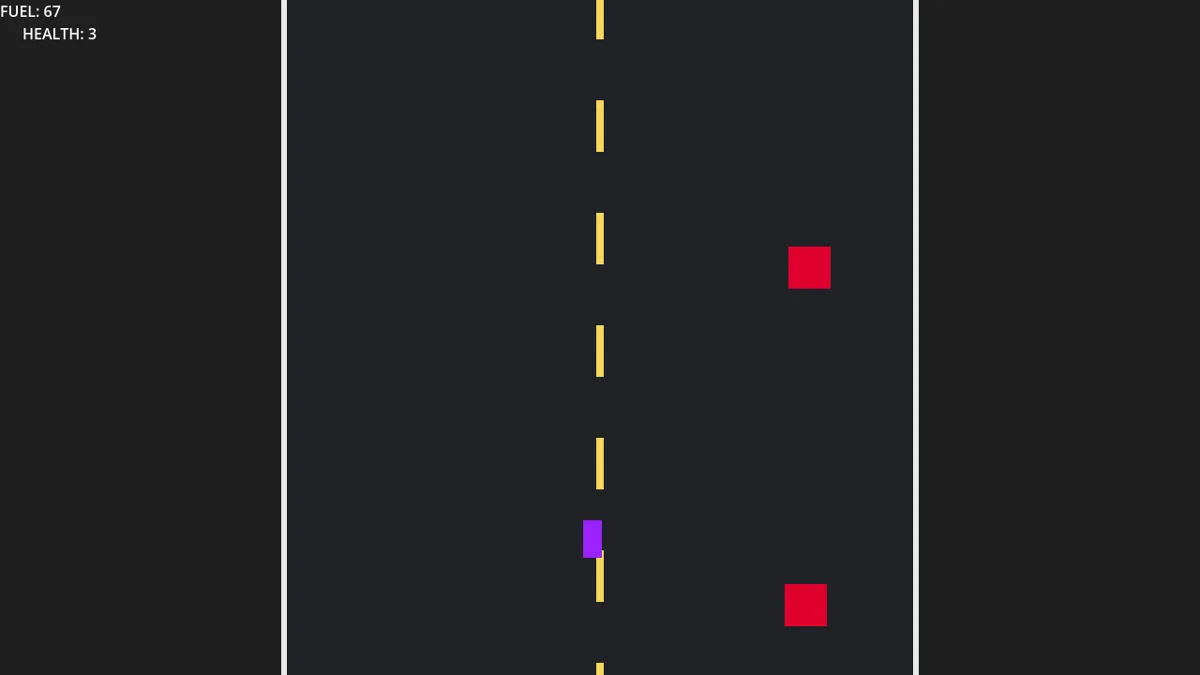
That means simply surviving isn’t enough.
You also have to reach home before the tank runs dry.
I added green fuel pickups next.
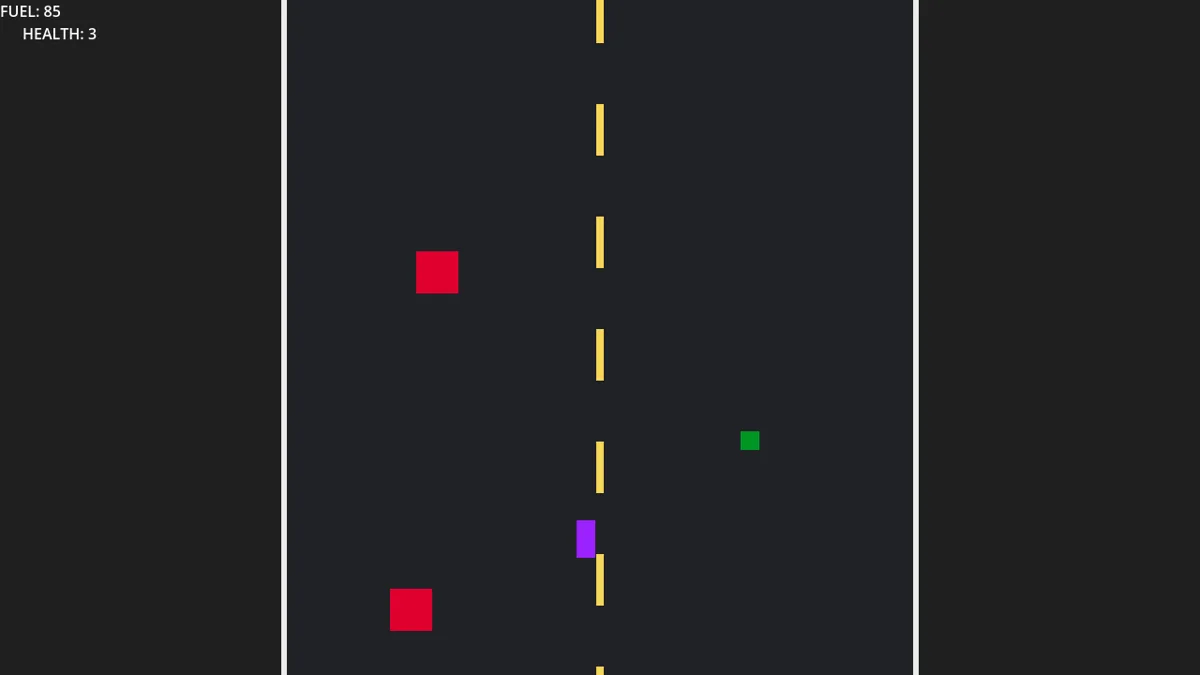
Drive into one and some fuel is restored, capped at 100.
Now there are two reasons to steer:
- avoid things that hurt you
- grab things that keep you moving
Simple, but already much more interesting.
Then the Actual Game Appeared
Everything up to this point could have belonged to almost any top-down driving game.
The important mechanic came next.
After driving for a while, the player reaches a junction.
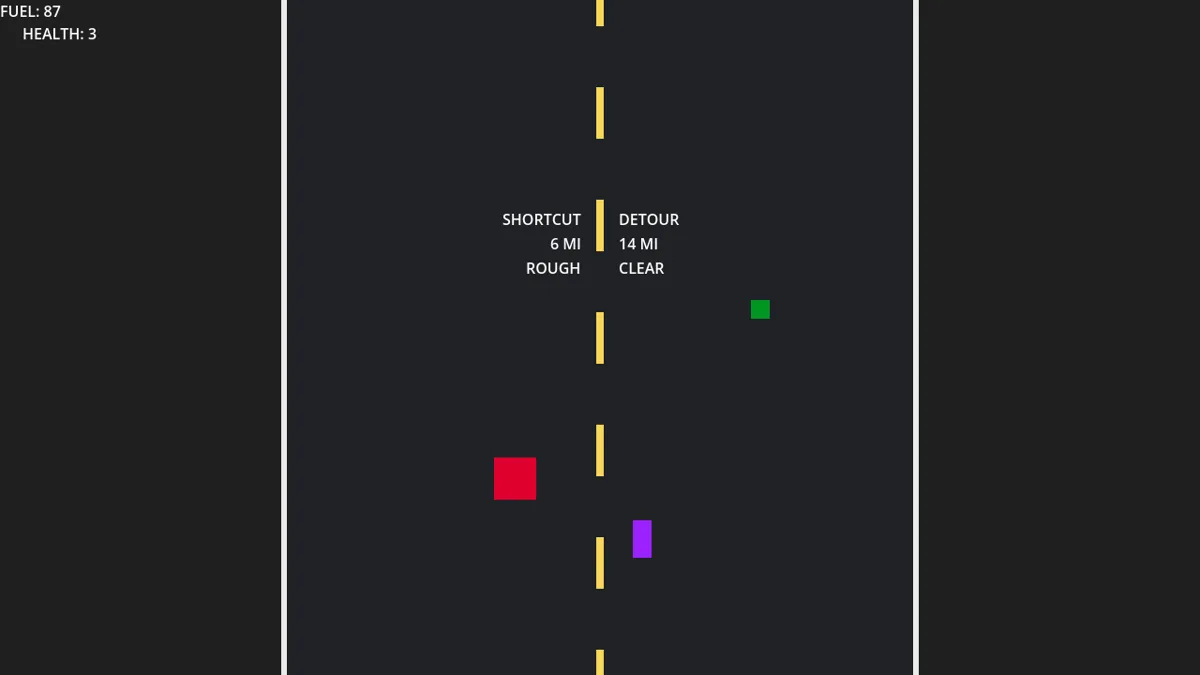
The player physically steers toward one of two choices:
SHORTCUT — 6 MI — ROUGH
or
DETOUR — 14 MI — CLEAR
The shortcut saves fuel, but increases the number of hazards.
The detour is safer, but burns more fuel.
That creates the interaction I wanted from the theme.
If you’re low on fuel but your car is healthy, the shortcut starts looking attractive.
If you’re nearly wrecked but have plenty of gas, the long road might be the smarter option.
Neither road is supposed to be universally correct.
And when I got the first fork working, that was the moment the prototype stopped being “a car avoiding squares” and started feeling like DETOUR.
Giving the Journey an Ending
The final goal for today was important:
I did not want to finish Day 1 with a game that could run forever.
A jam game needs an ending.
So the player now progresses through a set number of junctions while the HUD tracks how many stops remain before home.
After the final choice, the road clears.
A tiny placeholder house appears in the distance.
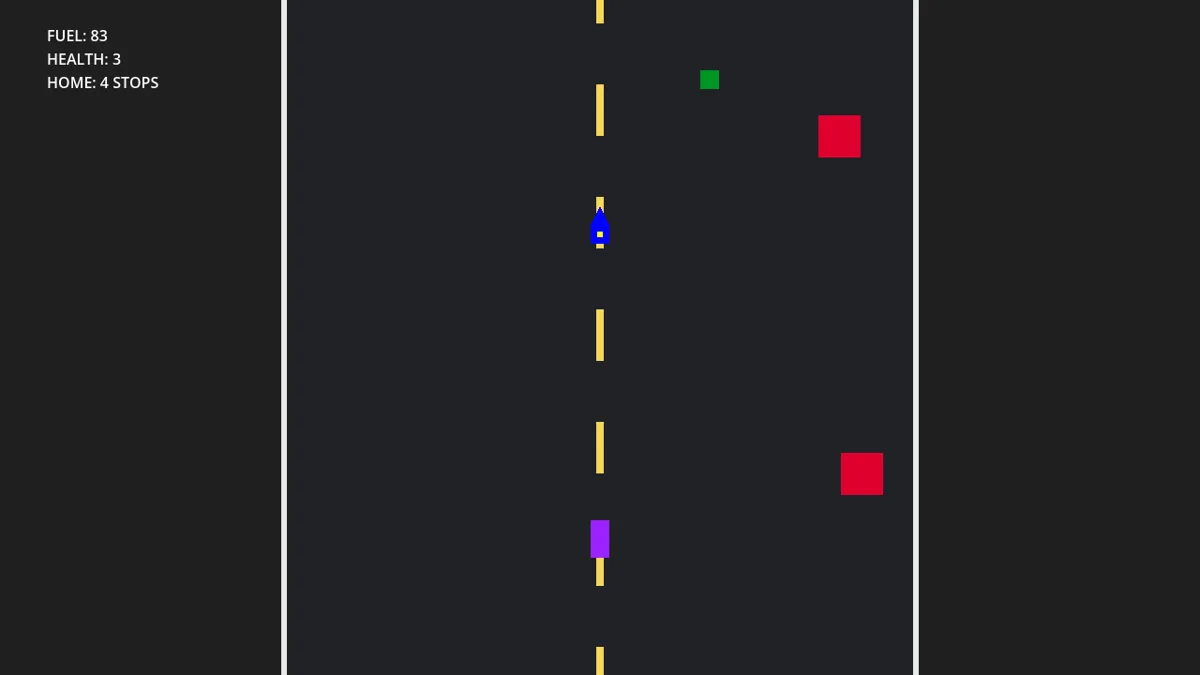
It is currently composed of a blue triangle, a rectangle, and a tiny yellow porch light.
It is perhaps the finest piece of architecture ever created.
Eventually it reaches the player and:
HOME
You made it.
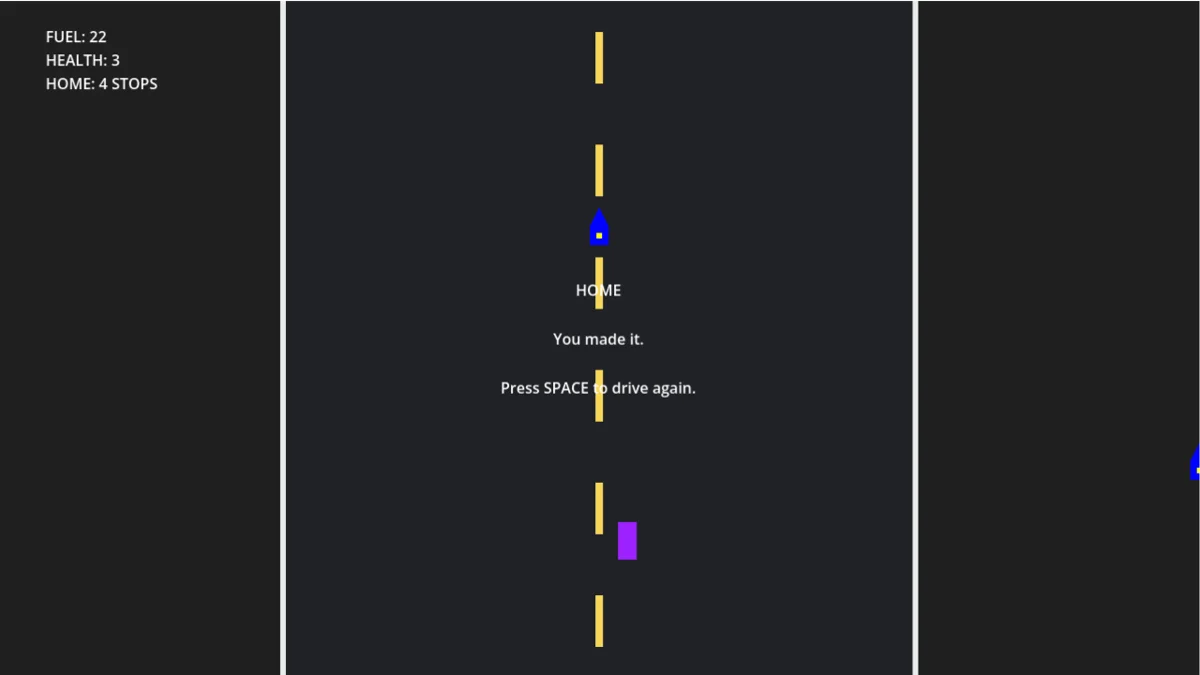
Press Space and the run starts over.
And that means, somehow, by the end of the first development session, the game now has a complete beginning-to-end loop.
What Exists After Day 1
The prototype now has:
- left/right steering
- an endlessly scrolling road
- randomly spawning obstacles
- collision knockback
- health and a wreck condition
- continuously draining fuel
- fuel pickups
- shortcut/detour junctions
- different risk/reward behavior depending on the chosen route
- progression toward home
- a win state
- restart after winning or losing
Visually, nearly everything is still colored rectangles.
That’s intentional.
My goal for today wasn’t to make the game pretty.
It was to answer one question:
Is there actually a game here?
I think the answer is yes.
The Biggest Lesson From Today
The most useful thing I did was resist the urge to start with artwork.
It would have been very easy to spend tonight making a car sprite, road textures, menus, lighting, or UI.
Instead, the order was:
movement → road → collision → resources → route choice → ending
Every step answered a gameplay question.
And because the entire loop now exists, anything I improve from here is improving a game that can already be played from start to finish.
That feels like a much safer place to be with six days left.
Tomorrow
The next phase is going to be about turning this prototype into something that feels intentional.
The big priorities are going to be:
- improving the route system
- cleaning up the player experience
- starting the visual direction
- figuring out how to communicate danger and fuel pressure without relying on debug-looking text
The ugly prototype has done its job.
Now DETOUR needs to start looking and feeling like a real game.
6 days left.
One road home.
No time for wrong turns.